The Great Synthesis: How AI, Stock Exchanges, and Respect for Sovereignties Are Turning Space into a Global Market – Image #1 An afterword to April 12, 2026, looking ahead… On previous Cosmonautics Days, we remembered Yuri Alekseyevich Gagarin. On this day, we saw not the past for the first time, ...
The Great Synthesis: How AI, Stock Exchanges, and Respect for Sovereignties Are Turning Space into a Global Market – Image #1
An afterword to April 12, 2026, looking ahead…
On previous Cosmonautics Days, we remembered Yuri Alekseyevich Gagarin. On this day, we saw not the past for the first time, but the future. And it turned out not to be about lone heroes, but about the faceless yet precise movement of a stock ticker.
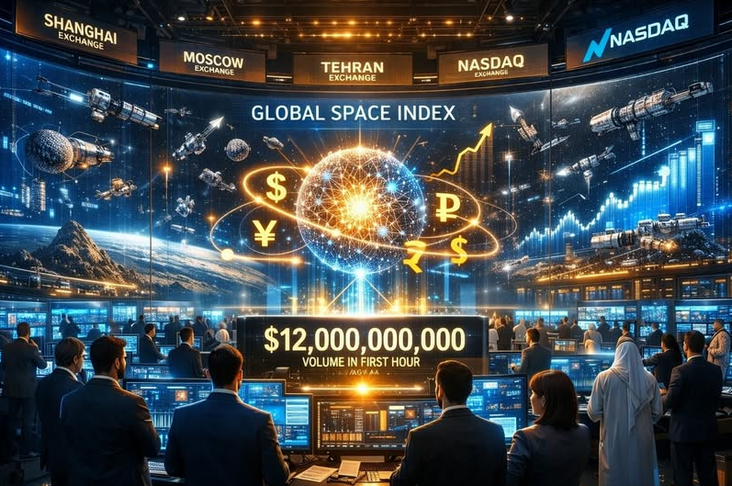
On April 12, 2028, on the Shanghai, Moscow, Tehran, and New York NASDAQ exchanges, as well as the Oman exchange, the first cross-listed futures on a global space index began trading. The index is calculated in a basket of five currencies (US dollar, yuan, ruble, rupee, rial) with automatic balancing through artificial intelligence. Within the first hour, the total volume exceeded $12 billion. Not a single political statement. The market simply said: "Space is now a liquid industry, not an epic saga."
This moment is the Great Synthesis. It didn't happen suddenly. It matured over decades, and four ingredients have now come together:
Space economy – ceased being a game of superpowers and became an industry with a turnover of >$600 billion.
Artificial intelligence – learned to manage satellites, risks, and currency baskets faster and more fairly than bureaucrats.
Stock exchange – finally remembered Marx's prophecy: fictitious capital (futures, indices) is needed to finance a future that doesn't yet exist.
Political will – not the abolition of competition, but its shift from the military to the pricing domain.
And crucially: the US is not excluded. On the contrary, without the US, this synthesis would be flawed.
Diagnosis of "Lone Ranger Disease" – and the universal cure
Just yesterday, every major space project suffered from the same ailment: loneliness.
NASA tried to return to the Moon (Artemis), but each new Congress reshuffled the budget.
Roscosmos heroically supported the ISS, but without private investment.
China built its own station (Tiangong), but largely in isolation.
Iran and India launched probes, but without the ability to share risks with others.
Space cannot be mastered alone. That's an axiom. Even the union of Iran, Russia, Central Asia, China, and India – for all their power – will not reach critical mass without a financial mechanism that allows each to remain themselves but act together. And this mechanism must include the US, at least as the largest investor and technological partner, because:
Capital: American exchanges (NYSE, NASDAQ, CME) provide >50% of global liquidity in space ETFs and futures.
Technology: Starlink, SpaceX, Blue Origin, Rocket Lab are drivers reducing launch costs from $10,000/kg to <$1,500/kg.
Data: American AI models for processing satellite imagery (Planet, Maxar) are indispensable for global monitoring.
Therefore, the cure is a cross-exchange basket where the US dollar has weight, but not a monopoly.
How the new space harmony works (including the US)
No supranational issuance. No "global central bank." Only four levels that automatically interface through AI clearing.
Level 1. Energy and technology bills (3–6 months)
Backed by real deliveries: from the Persian Gulf and Russia (oil, gas, uranium) – for the Eurasian part; from the US (liquefied gas, technologies, patents) – for the Western part. A physical cushion under any virtual trading.
Level 2. Futures on the Global Space Index (GSI)
The index includes shares of companies from all countries engaged in space: from SpaceX (USA) to ISRO (India), from CASC (China) to private Iranian satellite manufacturers. Futures are traded simultaneously on six exchanges (Shanghai, Moscow, Tehran, Mumbai, New York, Oman). The price is expressed in a basket of five currencies: USD, CNY, RUB, INR, IRR (weights are recalculated quarterly by AI based on real space trade volumes).
Level 3. Artificial intelligence as universal clearing
AI in real time:
recalculates the currency weights in the basket (so no country can artificially inflate its share);
manages collateral for futures, automatically converting it into the basket;
prevents arbitrage attacks between exchanges (e.g., differences in lunar futures prices in New York and Shanghai);
and importantly, does not succumb to political pressure, because its algorithms are specified in an open contract and verified by participating central banks (including the Fed).
Level 4. Open architecture for all.
Any country can join the system if it accepts the clearing rules and provides collateral in its own currency or real assets. No "clubs of the chosen." Only economic logic.
Why the US will agree to this (pragmatically, without ideology)
The United States is no naïve idealist. But it has three powerful incentives to participate in the Great Synthesis rather than boycott it.
Reducing budget pressure. NASA spends ~$25 billion per year. If part of lunar and Martian missions can be insured or financed through the global futures market, Congress will stop cutting budgets under the slogan "debt before space."
Access to Eurasian resources. Without participation in the basket, US companies will not be able to buy Iranian helium-3, Russian uranium, or Indian titanium alloys at market prices. And they need them.
Maintaining leadership through liquidity. If the US stays out, a parallel market (yuan + ruble + rial) with different pricing will emerge. This would split the space economy. By participating, the US retains the dollar as the largest, but not sole, component of the basket – that is, control without hegemony.
Key compromise: No sanctions restrictions within the system. If an Iranian company trades a future on NASDAQ, it is a technical transaction, not political approval of the regime. The exchange is neutral.
What this gives humanity…
Space agencies – the ability to plan missions 7–10 years ahead, not from budget to budget.
Countries with non-convertible currencies (Iran, Russia) – access to global capital without dollar intermediaries, but with the dollar's participation as a stabilizer.
American companies – new sales markets (satellites for Africa, launches for Southeast Asia) without political obstacles.
Private investors worldwide – a transparent tool to invest $100 in the future of asteroid mining.
Everyone else – new jobs, cheap satellite internet, data for agriculture, climate monitoring.
Space ceases to be a "destination" and becomes the habitat of the space economy. Like the internet in the 1990s. First surprise, then habit, then necessity…
Harmony, not utopia…
I could say that now we will all fly to the stars tomorrow. We will not. There are too many earthly problems.
I could say that the new system is perfect. It is not perfect. There will be algorithm glitches, political squabbles, attempts to manipulate the basket, and disputes over the weight of the dollar versus the yuan.
But here is what matters: humanity finally has a tool that makes space rational and inclusive. Not heroic, not ideological, not divided into "us" and "them," but boringly economic, like container shipping or cloud services. And boring reliability is precisely the path to the stars.
I once called the number 61.8% (the golden ratio) as a measure of harmony for the Eurasian part. Today, with the inclusion of the US and the dollar in the basket, the measure of harmony becomes 79%. Because the first cross-futures have already traded, AI made no mistake, and the currency basket withstood the first oil price spike and political crisis.
The remaining 21% are up to the politicians. But now they will have to catch up with the market, not the other way around. And that is good.
By way of conclusion.
In 1961, Gagarin said "Poyekhali!" (Let's go!) – and it was a cry from the soul. In 2028-30, a trading terminal will silently show a green number – and it will be a whisper of the system. Both events are great.
But it is the second that turns the first not just into a memory, but into an investment. We have finally connected the romance of space with the cold logic of the exchange, respect for sovereignty with the necessity of synthesis, human fears with machine precision, and the West with the East – through the understanding that there are no borders in space.
Happy Cosmonautics Day. It has now also become Investor's Day into Infinity.
Written with faith in reason and gratitude to those who seek not easy utopias, but working bridges.