I'd always been interested in space travel, since I could remember. My mom thought it was perhaps because the Challenger disaster happened several months before I was born. I think it was because I could see the stars so clearly from my childhood home. To this day, I can ...
I'd always been interested in space travel, since I could remember. My mom thought it was perhaps because the Challenger disaster happened several months before I was born. I think it was because I could see the stars so clearly from my childhood home. To this day, I can tell you my favorite star isn't a star - it's a Messier Object, M44, nicknamed "the Honeycomb". It was the brightest "star" in my bedroom window. Some kid's dad down the street had a telescope, and took really nice pictures of the Moon. The Space Shuttle flew regular flights. I knew a kid whose mom worked at Michoud. I read lots of books - one said we'd go to Mars in 2007. I studied hard, since that was two years before I was supposed to be graduating college. Lots of science. Lots of dragging my parents outside after dark to see constellations, or the space station Mir docked with a shuttle as it flew by.
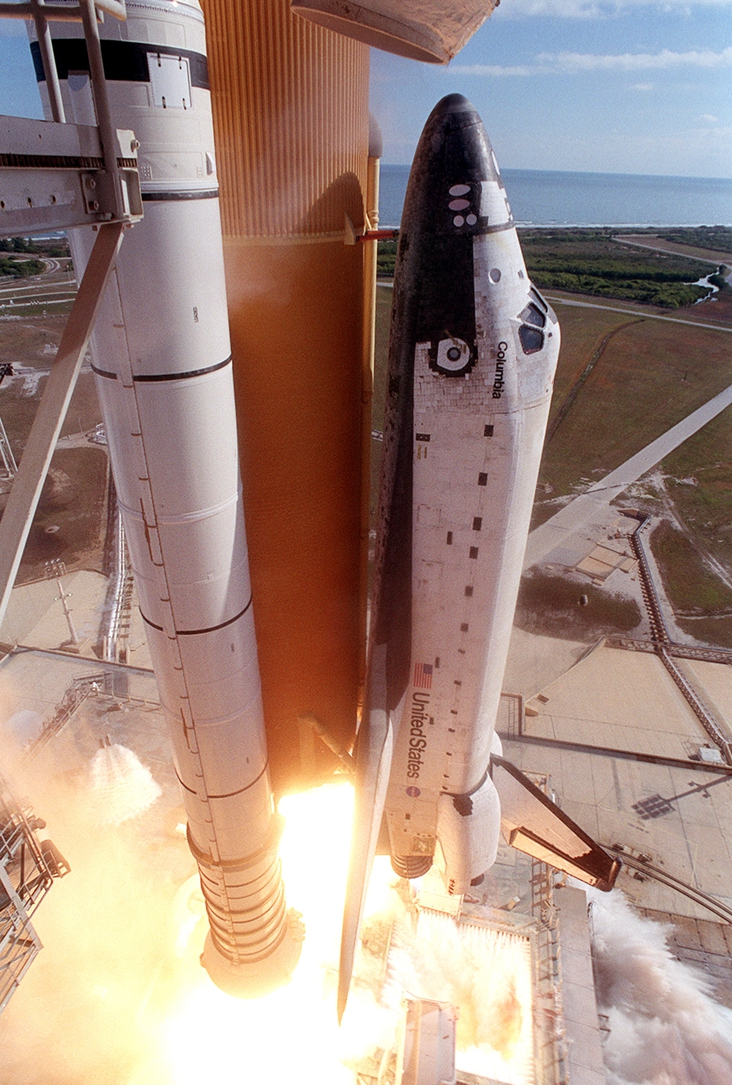
February 1, 2003, I was working on my social studies project in the living room. Dad had the TV on Fox News, as always. I was ignoring it ... until the reports started coming in about Columbia. Upon hearing that it had broken up, I felt worse than I had on 9/11. I watched as all of East Texas started looking for debris ... apparently an engine had landed in a lake in Shreveport ... I felt terrible. I knew then, that the blustery congressmen usually on TV wouldn't keep funding the Space Shuttle. After all, I was in high school, and it was older than me. I'd done research on NASA; I knew the cost of going to space was insane. The next Monday, the kid whose mom worked at Michoud looked like he hadn't gotten much sleep.
In 2007, I celebrated my 21st birthday still earthbound, my dreams long abandoned. I'd moved to Shreveport, where the shuttle engine landed in the drinking water supply. The lights were too bright to see many stars.
In 2011, I finally graduated college with a Bachelor of General Studies degree, a far cry from the scientific track I once pursued. A few months later, the Shuttle program ended.
About two months ago, I fell in love with space again. I've watched so many videos, mostly SpaceX launches/landings/simulations. I was a bit taken aback to find that people hadn't given up on space, or going to Mars. So many Earthly problems - why go into space? The answers came too easily - to improve life on earth; to preserve humanity; to EXPLORE.
I have a new goal: I'm going to be living on Mars by the time I'm sixty. I've got twenty-nine years until then ...