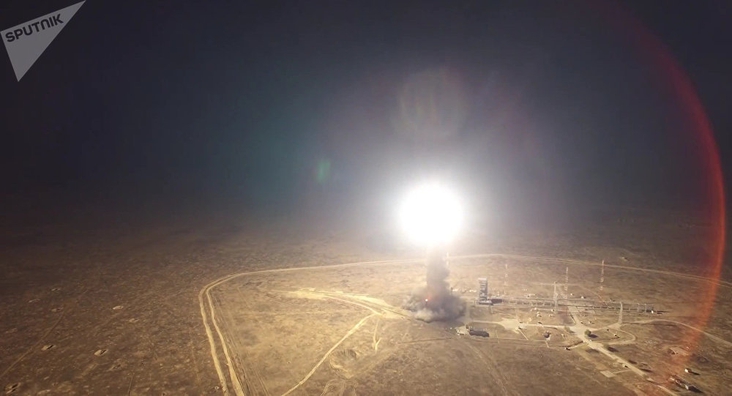
On December 26, Russia conducted the second test in almost two months of a Topol intercontinental ballistic missile.
"The strategic missile troops conducted the test launch of the intercontinental ballistic missile RS-12M Topol from the base of Kapustin Yar, Astrakhan region," the Ministry of Defense said in ...
On December 26, Russia conducted the second test in almost two months of a Topol intercontinental ballistic missile.
"The strategic missile troops conducted the test launch of the intercontinental ballistic missile RS-12M Topol from the base of Kapustin Yar, Astrakhan region," the Ministry of Defense said in a statement.
According to the entity, the aim of the launch was to test a new warhead for intercontinental ballistic missiles. During the test, "experimental data that will be used to develop effective means to circumvent missile defense" were obtained.
The RS-12M put to the test consists of a strategic mobile missile system capable of launching a three-stage intercontinental ballistic missile and solid fuel that is designed to attack strategic targets at distances of between 10,000 and 11,000 kilometers.
According to the Russian media Gazeta.ru, the "new warhead for intercontinental ballistic missiles" put to the test could refer to a maneuverable hypersonic warhead, whose development is already in its final stage, according to some sources.
According to Anatoli Skoliatni, military expert quoted by the media, if Russia manages to develop the missile whose project is already known as 'article 4202', capable of maneuvering vertically and horizontally at hypersonic speeds, then the country will have the ability to overcome any system of existing missile defense.
To counteract the missiles, the defense complexes define two points of movement of the warhead when calculating its trajectory and, thus, launch an anti-missile countermeasure. In the case of a controlled warhead, the trajectory could change several times during the flight, which would make it practically impossible to intercept it.
The previous Topol test launch was carried out as part of the strategic exercises on October 26. The intercontinental ballistic missile was then also launched from the Plesetsk cosmodrome, located in the northwest of the country, and after flying more than 5,000 kilometers hit the target on the Kamchatka peninsula. Two more missiles were fired from a submarine in the Sea of Okhotsk. The fourth ballistic projectile was launched from a submersible in the Barents Sea and shot down the target installed in Kamchatka.
On that occasion, in addition, a nuclear submarine of the Russian Pacific Fleet simultaneously launched two ballistic missiles from the waters of the Sea of Okhotsk towards the polygon of Chizha (in the province of Arjánguelsk), and a nuclear submarine of the Fleet. North launched a ballistic missile from the waters of the Barents Sea against the Kura polygon.
Also, in the simulation "strategic bombers Tu-160, Tu-95MS and Tu-22M3 were used, which took off from the airfields of Ucrainka, Enguels, Shaikovka, and launched cruise missiles against targets in polygons of Kura, Pemboi (Republic Komi), and Terekta (Kazakhstan), "he says.
The Ministry of Defense stressed that during the maneuvers all the tasks were fulfilled and all the simulated objectives were destroyed.
Subsequently, it was learned that the order to conduct the training was given by the Russian President Vladimir Putin himself. As part of the exercise, the Russian leader personally launched four missiles.